
Your brand might dominate Google’s first page and still be a ghost inside ChatGPT. Welcome to the new rules of discovery.
There’s a revenue leak in most marketing funnels right now, and majority teams are still not paying attention.
It works like this: a potential buyer opens ChatGPT (or Perplexity, or Gemini) and asks for a recommendation in your category. The AI gives a synthesized answer, not a list of links, explaining why each option fits and citing its sources.
Simply put, Google shows you options. AI picks for you.
The buyer no longer scrolls or compares ten tabs. They read, and they move. The entire buyer’s journey, research, shortlisting, validation, is compressed into one response. And, if your brand is in that answer, you just skipped half the funnel.
But if it’s not? The buyer never learns you exist. They found what they needed, picked a name the AI gave them, and moved on. You didn’t lose a ranking, instead something worse: you lost the chance to compete.
That invisible loss is what makes AI visibility different from every other marketing metric you’re tracking.
AI visibility measures how often your brand gets surfaced, cited, or recommended inside AI-generated answers, across ChatGPT, Perplexity, Google AI Overviews, Gemini, Claude, and every other platform where people increasingly go to make decisions.
This blog post is neither an oversimplified version of “just optimize your content for AI” or a piece drowning you in dashboards and data tables without explaining what’s actually happening underneath.
This is a proper breakdown of what AI visibility really means, how AI engines decide which brands to recommend, and how to get cited by AI. Let’s get started.
What Is AI Visibility, Exactly?
Let’s cut through the noise.
AI visibility is a measure of how often, how accurately, and how favorably your brand appears in responses generated by AI platforms like ChatGPT, Perplexity, Google AI Overviews, Google AI Mode, Claude, Gemini, and more.
It shows up in two primary forms:
- Brand mentions are when your brand name appears in an AI-generated response as a recommendation or reference, without a direct link to your site.
- Citations go a step further. It’s when an AI response includes a clickable link back to your content as a source for its answer. You get both the brand exposure and a clickable path back to your content.
Here’s the critical distinction from traditional SEO: you’re not competing for a spot in a list of ten blue links. You’re competing to be included into the answer itself; a single, synthesized response that a user reads, trusts, and acts on without ever visiting a search results page.
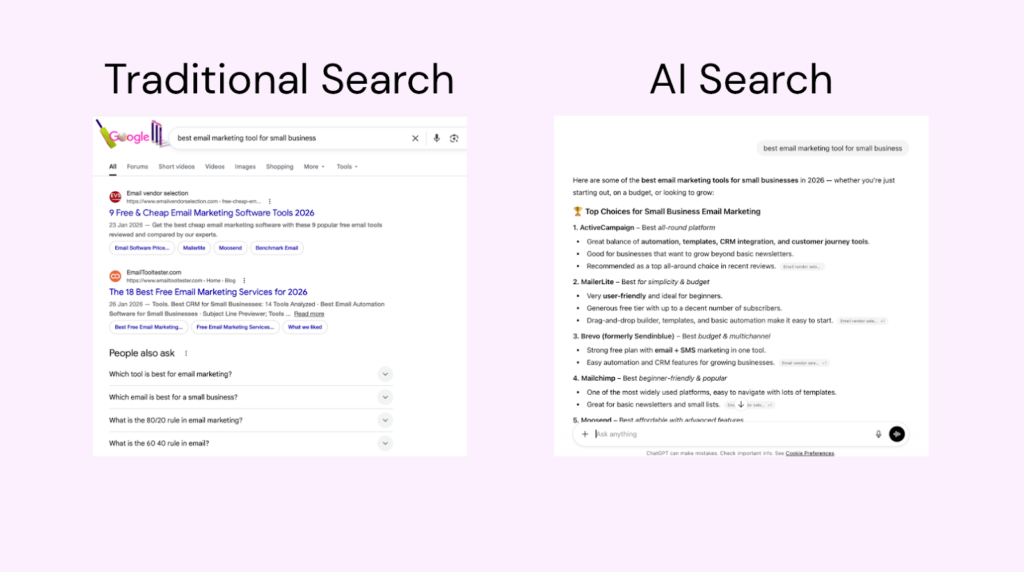
AI Visibility vs. Traditional SEO: The Fundamental Difference
I’ve had SEO professionals tell me, “We already rank well, so we’re fine.” And I get the logic. But AI visibility and SEO, while related, operate on fundamentally different mechanics.
SEO ranks pages. AI visibility surfaces entities.
Google evaluates individual URLs based on on-page signals, backlinks, and technical factors. AI engines build an understanding of your brand as an entity; what you do, who you serve, how trustworthy you are, by scanning thousands of sources across the web.
A single optimized page won’t cut it. The model needs to encounter your brand repeatedly, across diverse and credible contexts, before it develops enough confidence to recommend you.
SEO is mostly deterministic. AI is probabilistic.
This one took a while to sink in for me. When you rank #3 on Google for a keyword, you’re #3 for pretty much everyone searching that term (personalization aside). AI doesn’t work that way.
Rand Fishkin’s research at SparkToro (January 2026) is the most important data we have on this: after running 2,961 prompts across ChatGPT, Claude, and Google AI, his team found that the odds of getting the same brand recommendation list twice were less than 1 in 100. The odds of getting the same list in the same order? Less than 1 in 1,000.
This means, the same prompt, asked repeatedly, almost never returned the same list of brand recommendations. Same order? Essentially never.
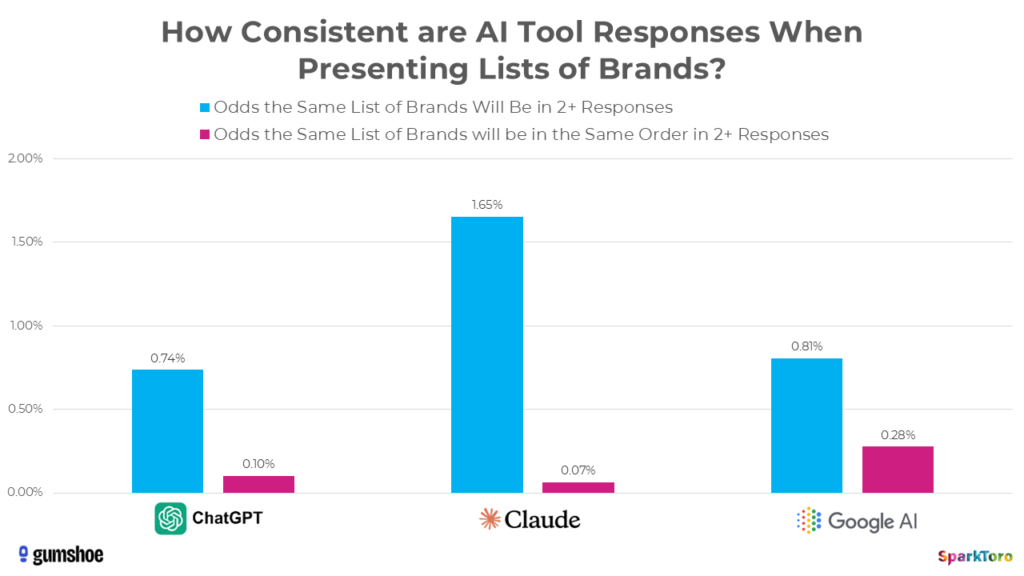
These models are probability engines. They sample from a distribution of possible answers each time. So “ranking #1 in ChatGPT” isn’t a thing. What is a thing: how frequently your brand appears across many runs of a similar prompt. That’s visibility percentage, and it’s the metric that actually holds up under scrutiny.
SEO rewards your own content. AI visibility rewards what the entire web says about you.
Your blog post, your landing page, your product page, all these matter for SEO.
But an AI engine forming its recommendation might draw from a Reddit thread, a YouTube review, a G2 comparison, and a Forbes article, none of which you wrote or control. Your brand’s AI visibility is shaped by the totality of your web presence, not just your owned properties.
That’s a paradigm shift in how we think about “ranking.”
Why This Matters Now (Not in Two Years)
The user base across AI platforms is enormous and growing. ChatGPT handles billions of prompts daily. Google’s AI Overviews appear in roughly a quarter of searches. Perplexity has tens of millions of monthly active users.
These aren’t experimental tools on the fringe anymore but mainstream discovery channels running alongside Google.
And the behavior shift is real. People are getting their answers, and their brand recommendations, inside the AI interface, then going directly to the recommended brand. Most AI Mode sessions on Google end without a single website click. The middleman (the search results page) is disappearing.
The traffic that does come through from AI referrals tends to convert better. These visitors arrive pre-qualified, the AI already vetted your brand and recommended it. That’s a fundamentally different kind of visitor than someone who clicked the third blue link.
The opportunity here isn’t about replacing what’s already working. It’s about capturing demand that your current channels can’t see.
Leigh McKenzie at Backlinko documented a case where they nearly tripled AI share of voice in a single month.
The brands investing here aren’t abandoning SEO, they’re adding a growth channel that compounds alongside it.
But forget the stats for a second. The most telling signal is what LinkedIn did.
Their marketing team, a team with world-class SEO chops, watched awareness-driven organic traffic erode and decided the old playbook needed rewriting. Inna Meklin and Cassie Dell described the shift as moving from “search, click, website” to “be seen, be mentioned, be considered, be chosen.” They built a dedicated AI Search Taskforce. They rewired their KPIs around citations, mentions, and LLM referral traffic.
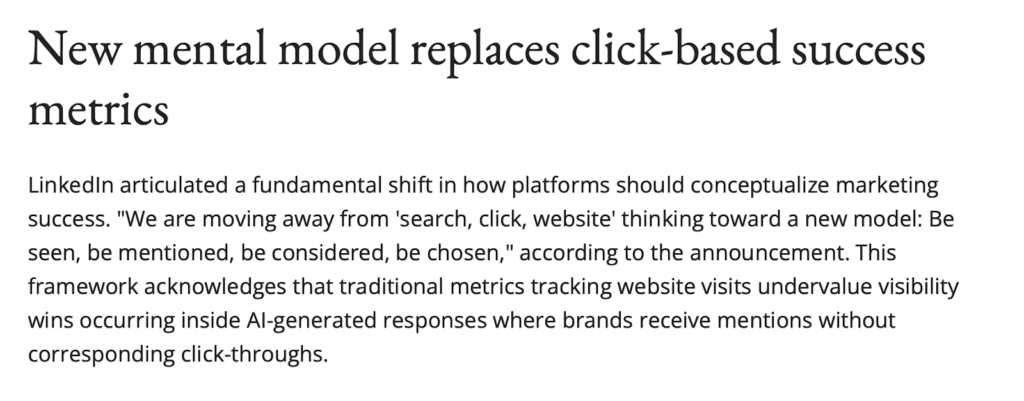
When LinkedIn treats something as an organizational priority, it’s probably not something your brand can afford to watch from the sidelines.
How AI Engines Decide What to Recommend
Understanding AI visibility requires understanding how these systems actually work under the hood. Not at a PhD level, but enough to inform strategy. LLMs generate responses through a combination of two mechanisms:
1. Parametric Knowledge (Training Data)
This is what the model “learned” during training. It includes patterns, associations, and entity relationships absorbed from the massive corpus of text the model was trained on.
If your brand has been written about extensively across authoritative sources like news publications, industry blogs, Wikipedia, technical documentation; the model has likely formed associations between your brand and specific topics, use cases, or categories.
But this knowledge is frozen at the model’s training cutoff. It doesn’t update in real-time. And it’s probabilistic, not exact, meaning the model has varying degrees of confidence about different entities.
2. Retrieval-Augmented Generation (RAG)
This is the real-time component. When a user asks ChatGPT or Perplexity a question, the system doesn’t just draw from training data. It actively searches the web (or a specific index), retrieves relevant sources, and uses them to ground its response.
This is where your current content, your current web presence, and your current brand signals matter enormously. RAG is the mechanism through which fresh content, new reviews, recent media coverage, and updated product pages can influence AI responses, often within days, not months.
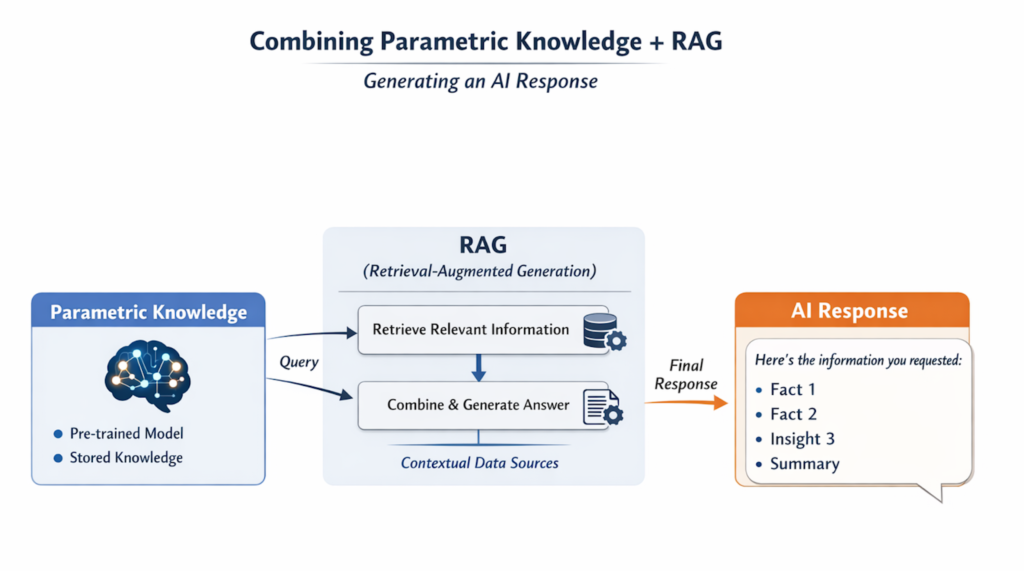
The balance between these two mechanisms is what makes AI visibility both challenging and exciting. A brand with strong parametric presence (lots of historical coverage) but weak RAG signals (outdated content, poor structure) will see inconsistent visibility. A brand with fresh, well-structured content but no historical entity footprint will struggle to break through.
You need both.
What Makes a Brand Consistently Visible in AI?
This is where it gets more interesting.
Fishkin found that while ranking position in AI is effectively random, visibility percentage (how often a brand appears across many runs of the same prompt type) is statistically meaningful.
Some brands show up 85-97% of the time for relevant prompts. Others appear sporadically at 5-10%. I’ve been tracking this across dozens of brands over the past year, and the patterns are remarkably consistent.
Multi-source corroboration
Visible brands exist everywhere, not just on their own site. They’re discussed on Reddit, reviewed on G2 and Capterra, mentioned in YouTube videos, cited in industry reports, and covered by news outlets. This multi-source presence gives the model repeated confirmation. One strong website alone doesn’t create that kind of entity confidence.
SE Ranking’s research supports this: brands with active profiles on review platforms showed significantly higher citation rates in ChatGPT. Brands with substantial discussion presence on Reddit and Quora had even higher rates.
Content clarity and structure
Another pattern with brands having strong AI presence is: their content is built for extraction, not just reading. LLMs don’t browse your page the way a human does. They extract specific, usable answers.
Studies have shown that a disproportionate share of citations come from the top portion of a page. If you bury your key point below three paragraphs of setup, the model might never surface it.
LinkedIn’s own testing confirmed this: pages with clear heading hierarchies and direct, front-loaded answers performed measurably better in AI citation rates.
Content Freshness
I can’t overstate this. Stale content drops out of AI rotation fast.
AirOps’ 2026 State of AI Search report found that pages going more than a few months without updates were dramatically more likely to lose visibility.
And when AI answers refresh, they replace a large chunk of their previous citations with newer sources.
Domain Authority
This still matters, but differently than in SEO.
SE Ranking’s data shows that sites with over 32,000 referring domains are 3.5x more likely to be cited by ChatGPT than sites with fewer than 200.
Brand Search Volume
Ahrefs found a strong correlation between how often people search for your brand name and how frequently AI models mention you.
Brand popularity measured by search volume shows high correlation with mentions in AI chatbots, especially ChatGPT.
How to Measure AI Visibility
Let’s be practical. If you’re going to invest in AI visibility, you need to measure it. Here’s what to measure:
What Works: Visibility Percentage
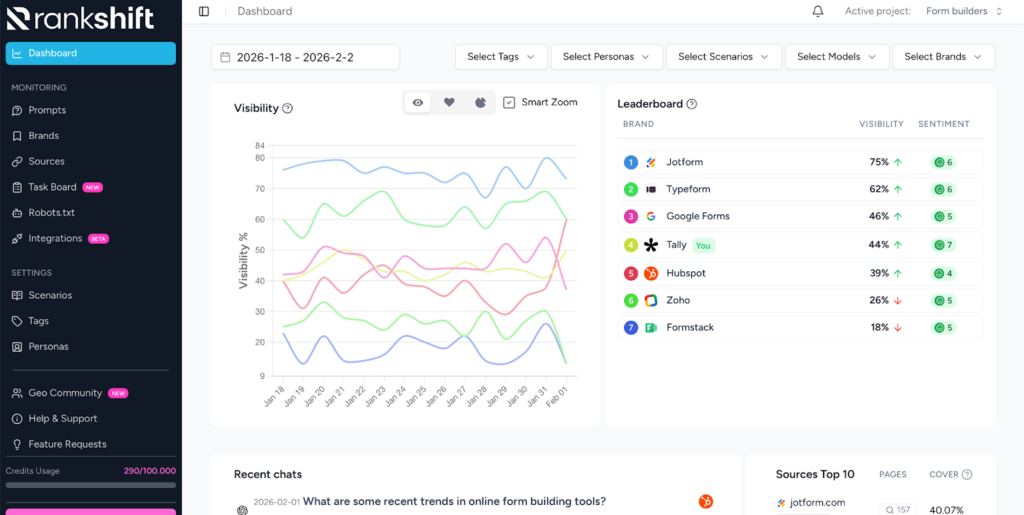
Track how frequently your brand appears across multiple runs of the same prompt type. A tool that runs your key prompts 50-100 times and tells you “Your brand appeared in 43% of responses” is giving you actionable data. This number can be benchmarked, tracked over time, and improved through optimization efforts.
What Doesn’t Work: Ranking Position
Any tool claiming to give you a “rank” in AI responses (e.g., “You’re #3 in ChatGPT for this query”) is providing data that, per Fishkin’s research, is statistically meaningless. Position varies wildly between runs. Don’t pay for it.
What to Track
- AI Share of Voice: Your brand’s mention frequency relative to competitors for a set of target prompts.
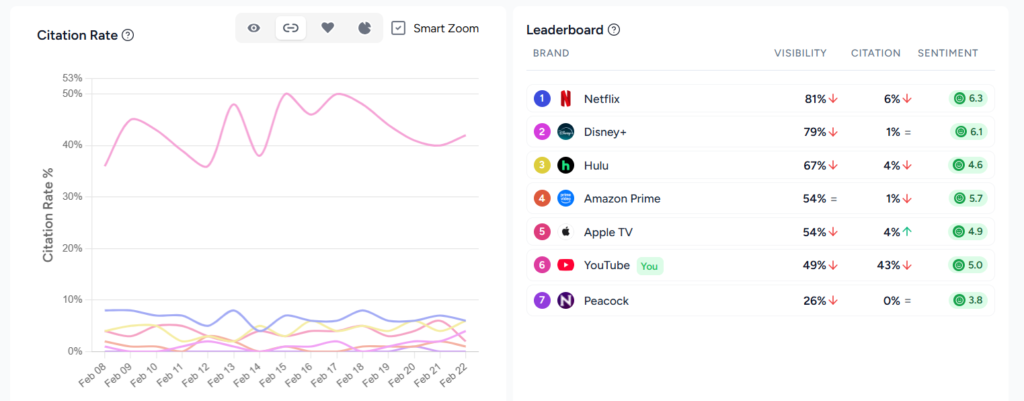
- Citation rate: How often AI responses link back to your content, not just mention your brand.
- Sentiment: How your brand is described when it does appear. Positive recommendation? Neutral mention? Negative framing?
- Platform coverage: Your visibility across different AI platforms. Recent research found that citation rates can vary by a factor of 46x across platforms. A brand thriving on Grok might be invisible on ChatGPT.
- Prompt categories: Break your tracking into top-of-funnel (category queries like “best CRM tools”), mid-funnel (comparison queries like “Salesforce vs. HubSpot”), and bottom-funnel (purchase-intent queries like “HubSpot pricing for startups”).
- Several LLM tracking tools can help with measurement: Rankshift AI, Ahrefs Brand Radar, and Semrush all offer some form of AI visibility tracking. The space is maturing quickly.
Now let’s move to the most important part, i.e., how to improve your AI visibility.
9 Strategies to Improve Your AI Visibility
Based on research, case studies, and data from early 2026, here are LLM optimization strategies that actually move the needle.
1. Structure Content for LLM Extraction
LLMs parse content to extract specific, usable answers. The structure of your content directly impacts whether it gets cited as a source.
What this looks like in practice:
- Answer the core question in the first 100 words of any page. Don’t bury it.
- Use clear, hierarchical headings that match common query patterns (e.g., “What is [topic]?” as an H2).
- Mirror heading syntax in your opening sentences. If your H2 says “What Is AI Visibility?” the first sentence should begin with “AI visibility is…” This pattern makes it trivially easy for LLMs to extract a definition.
- Use specific, verifiable claims with numbers rather than vague assertions. “Revenue increased 34% in Q3” beats “Revenue increased significantly.”
- Implement schema markup. Websites with author schema are 3x more likely to appear in AI answers. FAQ schema also correlates with higher citation rates.
This isn’t about gaming an algorithm. It’s about making your content genuinely machine-readable. LLMs need to extract a clean, confident answer. If your writing makes that easy, you get cited more often.
2. Build Your Entity Footprint Across the Web
Your website alone isn’t enough. LLMs build entity understanding from the totality of what the web says about you.
This means actively building presence on the platforms these models crawl and cite most heavily. According to Ahrefs, the top platforms for AI citations include Wikipedia, Reddit, YouTube, Forbes, G2, and similar high-authority domains.
Actionable steps:
- Create or update your Wikipedia page (if you’re notable enough to warrant one, follow Wikipedia’s notability guidelines).
- Participate authentically on Reddit in subreddits relevant to your industry. Don’t spam. Add genuine value. Reddit is cited in roughly 1 in 5 AI answers.
- Maintain updated profiles on industry review platforms (G2, Capterra, Trustpilot, etc.).
- Get your brand mentioned in YouTube content, both your own channel and via partnerships with relevant creators. YouTube is consistently one of the most-cited platforms across AI models.
- Publish on LinkedIn regularly. LinkedIn is the second-most-cited source in LLM responses.
3. Earn Brand Mentions From Trusted Sources
In traditional SEO, the game was backlinks. In AI visibility, the game is brand mentions, linked or unlinked.
AI models don’t just follow links. They process text. If your brand is mentioned in the context of “best project management tools” across 15 trusted sources, the model builds a strong association between your brand and that category, regardless of whether those mentions include hyperlinks.
This is where digital PR becomes a direct AI visibility lever. Get featured in industry publications. Earn expert quotes in relevant articles. Get included in “best of” roundups from authoritative sites.
The brand mention strategy overlaps heavily with traditional PR but with a critical difference: the volume and breadth of mentions across diverse source types matters more than getting one big placement.
4. Keep Content Fresh
The data here is unambiguous. Stale content loses AI visibility.
AirOps found that pages going more than three months without an update are over 3x more likely to lose visibility. And over 70% of pages cited by AI have been updated within the past year.
Build a content refresh cycle into your editorial calendar. Prioritize your highest-value pages, the ones you want AI to cite for your most important queries. Update statistics, add recent examples, revise outdated sections, and change the last-modified date.
Freshness is one of the most controllable levers you have.
5. Optimize for Conversational Queries
People don’t talk to AI the way they type into Google. AI prompts are longer, more conversational, and more specific. Someone might type “best CRM” into Google but ask ChatGPT “What CRM would work best for a 15-person B2B SaaS company with a limited budget that needs HubSpot-level features?”
Your content needs to address these longer-tail, intent-specific queries. Product pages, comparison pages, and use-case pages should be written to match the way people talk about their needs, not just the keywords they search.
This also means creating content for specific segments and scenarios. A generic “Best CRM Tools in 2026” page is less likely to be cited for a specific prompt than a page titled “Best CRMs for Small B2B Teams Under 20 People.”
6. Make Your Site Accessible to AI Crawlers
This is the technical foundation. If AI bots can’t crawl your site, nothing else matters.
Check your robots.txt. Many sites have inadvertently blocked AI crawlers like GPTBot (OpenAI), ClaudeBot (Anthropic), or PerplexityBot. If you want AI visibility, you need to allow these crawlers. Therefore, perform regular log file analysis for AI bots and crawlers.
Consider implementing an llms.txt file, a lightweight text file that helps LLMs understand your site structure and key content. While its direct impact is still being studied, it signals AI-friendliness and provides structured context about your site.
Also: technical performance matters. SE Ranking data shows that pages with fast loading times (FCP under 0.4 seconds) average 6.7 citations, while slower pages average just 2.1.
7. Create Citable, Data-Rich Content
AI models love content that contains specific, citable data points. Original research, proprietary data, surveys, benchmarks, and statistics all perform well.
Content with statistics, citations, and quotations achieves 30-40% higher visibility in AI responses according to multiple studies. This makes intuitive sense, when an AI needs to support a claim in its answer, it reaches for content that provides evidence.
If you can produce original research relevant to your industry, do it. It’s one of the highest-ROI content investments for AI visibility.
8. Monitor and Manage Your Brand Narrative
AI models don’t just surface your brand, they describe it. And the sentiment and framing of those descriptions matter enormously.
Regularly audit how AI platforms talk about your brand. Ask ChatGPT, Perplexity, and Gemini questions like “What is [your brand]?”, “Is [your brand] good for [use case]?”, and “What are the pros and cons of [your brand]?”
If you find inaccurate information, outdated descriptions, or negative framing, that’s your optimization roadmap. Update your own content to correct misconceptions. Earn new coverage that reframes the narrative. Address negative reviews and build positive user-generated content.
9. Track, Measure, Iterate
AI visibility isn’t a “set it and forget it” channel. AI responses are volatile, AirOps found that AI Overview content changes roughly 70% of the time for the same query, and when answers update, nearly half the citations get replaced.
Build a regular cadence of measurement. Track your visibility percentage, share of voice, and citation rates monthly. Compare across platforms. Identify which prompts you’re winning and which you’re losing. Run experiments; update a page, build mentions on a new platform, publish fresh research, and measure the impact.
What’s Coming Next
A few things I’m watching closely.
Agentic AI will change the stakes. ChatGPT’s Agent Mode and similar features mean AI won’t just recommend your brand, it’ll take action on behalf of users. Book a reservation. Start a free trial. Make a purchase. If your brand isn’t visible to these agents, you’re invisible at the point of transaction.
Paid AI placement is coming. Perplexity and OpenAI are experimenting with sponsored results inside AI responses. Organic AI visibility will eventually sit alongside paid AI visibility, the same way organic and paid search coexist today.
Platform differences will get sharper. Our own research found that citation rates can vary massively across different AI platforms; same brand, same content, wildly different visibility. Multi-platform tracking won’t be optional.
The Bigger Picture
I want to end with an honest perspective, because there’s been a lot of breathless coverage in this space.
AI visibility is not replacing SEO. Search engines aren’t disappearing. Google still processes billions of queries daily, and for plenty of use cases, people prefer evaluating a list of links themselves over trusting a single AI-generated answer.
But AI visibility is adding a fast-growing layer to how people discover and evaluate brands. And unlike SEO, where you had two decades to learn the rules, this channel is evolving in months, not years. The brands building entity confidence now, investing in multi-source presence, keeping content fresh, structuring for extraction are creating advantages that compound.
SEO tells Google what your pages are about. AI visibility tells LLMs what your brand is about. You need both. But only one of them is growing at the rate where ignoring it for another six months puts you meaningfully behind.
The brands that show up in both search results and AI answers aren’t choosing between channels. They’re stacking them. And right now, that second layer is where the biggest gap exists between the brands that are paying attention and the ones that aren’t.
Want to see how your brand actually shows up across AI platforms? Rankshift AI tracks your visibility, identifies gaps, and helps you build the kind of entity presence that gets you into the answer.
